


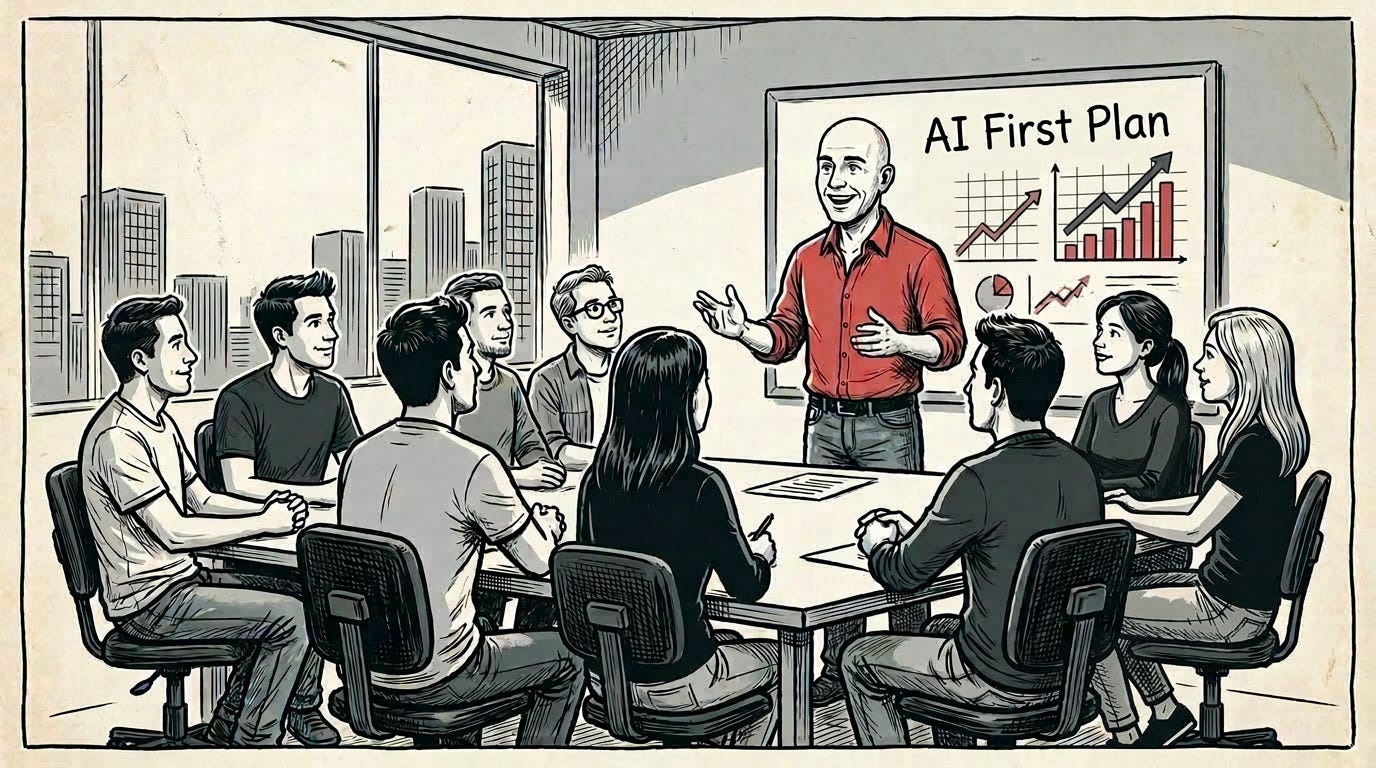
Just before WBN’s leadership team gathered in the Dominican Republic in early March, Mustafa Suleyman, the CEO of Microsoft AI, told the Financial Times that most white-collar work (lawyers, accountants, project managers, marketers, anyone sitting at a computer) will be fully automated by AI within 12 to 18 months. I shared that quote with the team and added my own take: whether his timeline proves accurate or not, the technology to do what he’s describing largely exists today. What’s still developing are the interfaces that make it accessible to everyone, the ability to integrate company-specific data so AI can work in real business context, and the job retraining that will be necessary as workers shift from doing the work to overseeing the AI that does it.
And for a company like WorkBetterNow, that coming transition hits close to home.
Why This Is Personal for Us
WBN is a talent company. What we do, finding, vetting, and placing great people, is exactly the kind of work AI is beginning to reshape. That creates two opportunities we’re focused on.
The first is competitive. We’ve earned multiple Inc. 5000 recognitions, an Inc. Power Partner Award, and NPS and eNPS scores that are at or near world-class. We want to use AI to build on that and add even more value to our CPs and clients.
The second is about our clients directly. A growing part of our value is placing “AI-enabled” Certified Professionals who are equipped to support our clients’ own AI efforts. We can’t do that credibly without going AI-first ourselves, and that single reality, more than anything else, is what drove the decision.
How We Got Started
When ChatGPT launched in late 2022, I knew pretty quickly this was significant. My partner Andrew and I encouraged everyone at WBN to start experimenting, with some guardrails around things like not using proprietary client data, and launched an internal “AI Show and Tell” where people shared what they were trying, what worked, and what didn’t.
That was the right starting point. By 2025 we had a lot of people using AI individually, just nothing coordinated.
In the meantime, I’d started building things myself. I’d been thinking about a problem we see constantly: small and midsize businesses generally aren’t great at writing job descriptions. They’re often not compelling enough to attract the right candidates, or not accurate enough to help us make the right match. A weak job description makes finding the right fit harder for everyone.
So I built a custom AI tool designed specifically to improve job descriptions. Clients appreciated the clarity and accuracy of what it produced, and our recruiting team found it led to better matches. Just a willingness to try something and figure it out as I went.
That experience showed me what was possible. But a course I took in late summer 2025 shifted my thinking further. The course was from OwnersRx, run by Alan Pence. One session in particular stood out: we had two hours to research a business concept, build it out, and launch a website, all using AI. What struck me was the speed, yes, but more than that, watching AI operate agentically, working somewhat on its own, taking actions and making decisions with increasing autonomy. That’s qualitatively different from AI as a writing or thought partner. When I saw that, the implications for our business became impossible to ignore.
The Decision to Go AI-First
Shortly after that course, I brought a new framework to WBN’s leadership team: WorkBetterNow was going to become an AI-first company.
AI-first, as we define it, means that any workflow that can be done by AI will be done by AI. The key distinction is that we’re not taking existing workflows and tweaking them. We’re rebuilding them from the ground up, with AI doing the work and humans designing, overseeing, and continuously improving those processes, with AI’s help in doing that too.
And it’s not just about efficiency, though that matters. It’s equally about effectiveness, getting better outcomes, not just faster ones.
We were clear from the start: this isn’t about eliminating jobs. As a fast-growing company, our goal is better outcomes and, as we scale, less need for additional headcount. We also know this requires a real transition, helping people move from doing the work directly to managing the AI that does it. We’re using third-party AI training courses to help the entire team build practical skills.
What We Saw at the Retreat
AI-first was the cornerstone topic when WBN’s leadership team gathered in early March, and every department head presented on what they’d already done and what they were working on. Andrew and I weren’t sure what to expect. What we heard genuinely surprised us. The progress was further along than either of us had realized, and watching departments inspire each other with what they were building was one of the better moments I’ve had as a business owner.
A few highlights from where we are right now:
Our finance team has deployed several AI-first workflows and is saving approximately 140 work hours per month. As a result, a department we had planned to staff with two additional people to accommodate our growth now needs one.
Our IT department is worth highlighting for a specific reason: unlike most companies our size, we handle our own IT support internally. The team rolled out an AI chatbot to handle routine first-level support tickets that previously required a person, freeing them to focus on helping other departments build their own automations and AI workflows. Our head of IT, Silvana, is now finding someone to run the department so she can focus almost exclusively on working with departments on their AI-related projects, tackling increasingly impactful workflows across the company.
Every department, recruiting, talent coordination, sales, is rebuilding workflows. We run EOS, and right now a significant number of our Quarterly Rocks are AI-related. When your priority-setting system starts reflecting your stated commitment, you know it’s real.
What This May Mean for You
In my opinion, before you can lead a meaningful AI effort at your company, you need to understand what AI can actually do today and where it is going. The best way to get there is to build something yourself. Take a hands-on course where you’re actually creating with AI, not just reading about it. If that’s not feasible right now, spend some time watching recent demonstrations of what tools like Claude can do, particularly the agentic capabilities. The potential becomes real when you see it in action.
Get behind the effort at your company. Appoint a leader, make it a genuine priority, and treat it like the transformation it is. Your team will take their cues from you.
WBN isn’t a tech company. We’re a fully remote talent company with most of our team in Latin America, and we’re doing this. If we can, you can.